Marketing and Technology sitting in a tree, K-I-S-S-I-N-G. First comes love, then comes marriage, then comes MarTech in a baby carriage.
Marketing and Technology consummated their union with the birth of last week’s MarTech Boston. The first-ever conference dedicated to marketing technology leaders, MarTech kicked off August 19th at the Seaport Hotel Boston and featured speakers from Kimberly-Clark, Gartner, BitTorrent, IBM, and Adobe.
I had the pleasure of attending day one of the two-day conference, witnessing the energy in the room as Conference Chair and Author of ChiefMarTech.com Scott Brinker first took the stage. Brinker is the creator of the Marketing Technology Supergraphic, which current version breaks down 947 software vendors for marketers, organized into 43 categories across 6 major classes:
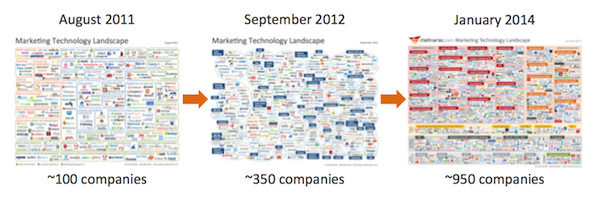
(Click here for a high resolution, zoomable version of the 2014 edition.)
With this supergraphic in the background, Brinker explained the growing intersection of marketing, strategy, and technology. He then brought his rhetoric to life in introducing Mayur Gupta, Global Head of Marketing Technology and Operations at Kimberly-Clark.
If there is one thing I recall from Gupta’s presentation, it is his instruction to the audience to “accept that you are consciously incompetent”. Pointing to Brinker’s supergraphic as evidence, Gupta highlighted the impossible speed by which the marketing technology landscape is changing and the criticality of investing in the right resources to stay on the cusp of emerging technology.
Up next was perhaps the most insightful speaker of the day, Laura McLellan, Vice President of Marketing Strategies at Gartner. McLellan led with “everything we see points to increased integration”. Boldly stating, “CIOs and CMOs can’t work together? That’s garbage. The collaboration is already occurring”.
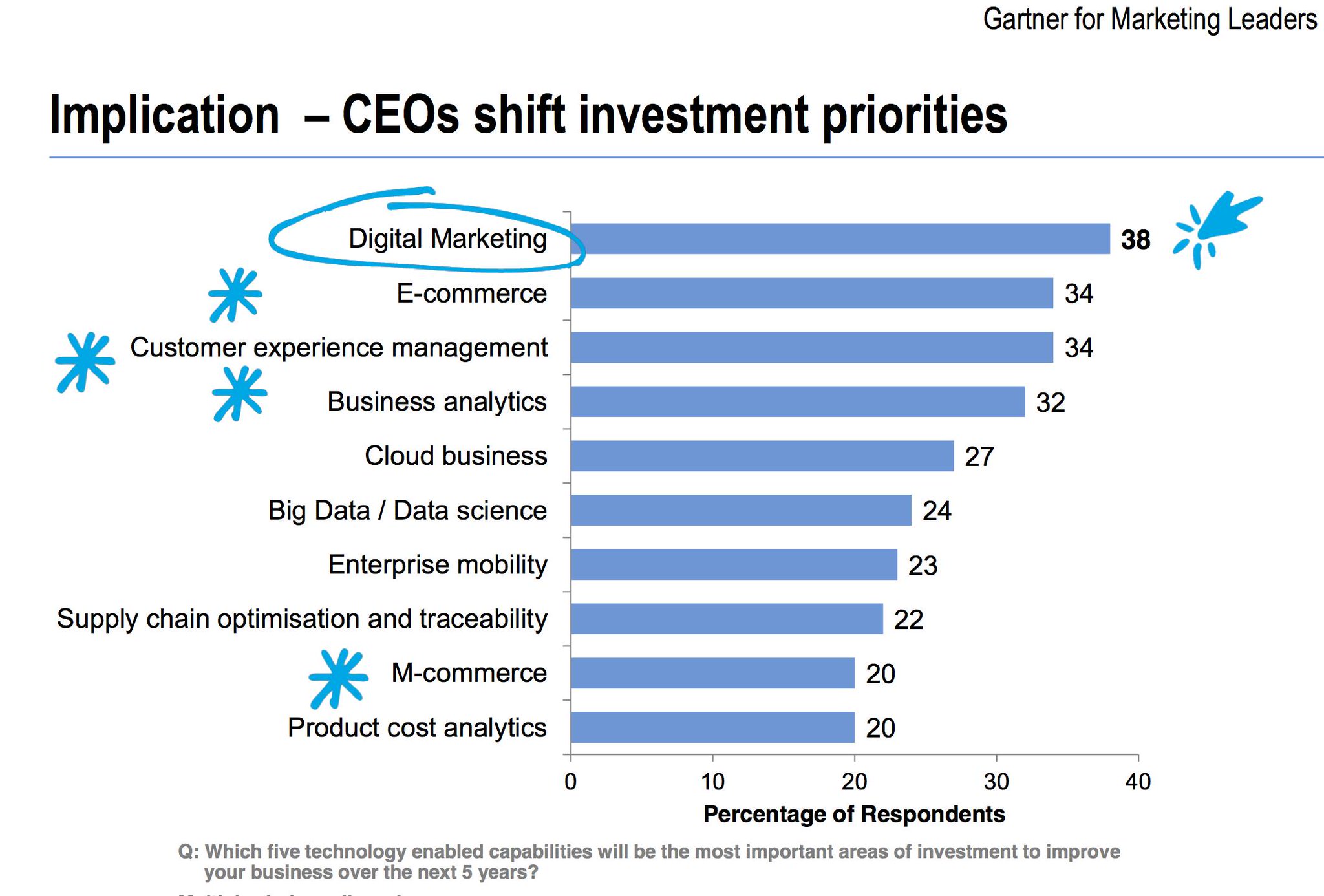
In fact, “marketing is already spending more on tech than the IT department, whether or not we actually say it”. This isn’t the only shift that is occurring; 38% of the CEOs Gartner interviewed have moved investment priorities to digital marketing. Where have the funds come from? 1) Reallocation, 2) incremental budget, and 3) wait for it… SALES budget.
Another standout from the first day of MarTech was Brightcove’s lunch presentation on “How to Drive Engagement in a World of Content Overload”. Here I learned the average attention span of a human is 7 seconds, while that of a goldfish is 9. As a result, 70% of B2B content today never gets used… so how do you break through the noise?
Hint: Brightcove is a video company. And pages with video attract 2-3x more visitors with an average 75% increase in conversion. Even with its virtues, Brightcove noted that “video shouldn’t be a condiment”. What is your NBA or “next best action” you want your viewers to take following the end credits?
The award for most entertaining speaker of the day went to Travis Wright, CEO of ThinkLabs. Wright’s presentation was single-handedly the best use of memes and animated GIFs I have ever seen, keeping the audience engaged during what I tend to term the “yawning hour” of 4pm. Wright spoke on the subject of “To Build or Buy Your Own Marketing Cloud?” which may have been dry, if not for his endless supply of wit and “bro” references.
The day concluded with a reception of wine and robots. Networking opportunities were plentiful, and I was able to connect with a number of industry leaders to exchange conversation and business cards. I can’t wait for next year!
Were you at MarTech? Share your thoughts in the comments below! What did you feel the biggest takeaway of the day was? And if you attended day two, which day did you prefer and why?
You can also tweet your comments to @Amanda_Healy – I look forward to hearing from you!