Revisting the Network Strength Pyramid for 2008

Back in time

One of my first blog posts ever, was on my previous blog “Driven-to-succeed,” which was built on October 4th, 2006. As some of you may know, I leveraged all the relevant content from my past blog for this one. The blog post introduced a working model for networking, which I called the “Network Strength Pyramid.” The intention with developing this simple model was to show you, not just how critical networking is, but that the strength of your relationships would increase the chances for you to get opportunities. Your family is your strongest connection, followed by friends and then acquaintances sit at the bottom.

Networking in 2008

The economic trends that I’ve been closely watching since January are really scaring people. Before I was born, networking was an option. You could have a single interview and claim a position, solely based on your skills. Today, more attention is paid on who you know, who they know and so forth (LinkedIn models this). Companies want to eliminate risk and receive recommendations in the form of personal endorsements.

The unemployment rate has fallen to 5.4% this month from 5.5% last month (Labor Department). More bad news comes in the form of the amount of layoffs that have occurred recently. 60,000 positions will be cut from U.S. payrolls in June and 49,000 were cut in May. This is the 6th consecutive month of job loses.

Why networking? Why now?

As the population increases, the amount of jobs decrease and the amount of people receiving degrees increases, you can imagine how hard it is to get a job. Despite the economy, competition will always grow, not just in your professional career, but the growth in small businesses and consultants will exponentially grow. When everyone has similar skills, the only way to get a job is through another person (see my earlier post about performing a people search). When you realize that the people you know are more important than what you’ve learned in school, you will be more successful.
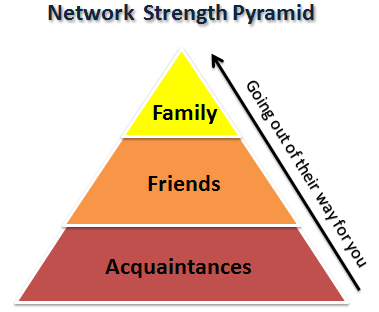
Network Strength Pyramid

Going out of their way for you

The more and more I thought about this model, the more I viewed the object of networking is to be close enough of people that they would go out of their way for you. When you have built rapport and a relationship, the chances someone would drop what they are doing to help you increases significantly. Most people won’t be compelled to go out of their way for you when you meet them for the first time. Acquaintances expect more out of you to gain trust.

If you provide for them first, then you can start to convert them into a friend. Although you can’t turn a friend into a family member (unless meet an acquaintance of the opposite sex and marry her), a friend is still high enough in the pyramid to want to help you.

Tip: Reach out to 5 people each day and see how you can serve them.

Picture of Dan Schawbel

Dan Schawbel

Dan Schawbel is the Managing Partner of Millennial Branding, a Gen Y research and consulting firm. He is the New York Times and Wall Street Journal bestselling author of Promote Yourself: The New Rules For Career Success (St. Martin’s Press) and the #1 international bestselling book, Me 2.0: 4 Steps to Building Your Future (Kaplan Publishing), which combined have been translated into 15 languages.

TRENDING AROUND THE WEB

Harvard Business School researchers studied more than 2,000 real speed-dating conversations among 110 daters and found that people who kept turning the topic back to themselves, instead of asking even one follow-up question, were the ones routinely read as having weaker social skills.

Harvard Business School researchers studied more than 2,000 real speed-dating conversations among 110 daters and found that people who kept turning the topic back to themselves, instead of asking even one follow-up question, were the ones routinely read as having weaker social skills.

Global English Editing

Ask a woman in her sixties what she wants to do with a free Saturday, and many go quiet, not for lack of preferences, but because decades of quietly editing their own desires to match someone else’s have left them without an easy way back to what was theirs to begin with.

Ask a woman in her sixties what she wants to do with a free Saturday, and many go quiet, not for lack of preferences, but because decades of quietly editing their own desires to match someone else’s have left them without an easy way back to what was theirs to begin with.

Global English Editing

Economists studying happiness data from more than 130 countries found that well-being typically bottoms out around age 47 or 48, then rises again through later adulthood — meaning the average happiness curve often improves well beyond midlife rather than continuing to decline with age.

Economists studying happiness data from more than 130 countries found that well-being typically bottoms out around age 47 or 48, then rises again through later adulthood — meaning the average happiness curve often improves well beyond midlife rather than continuing to decline with age.

Global English Editing

Psychologists at the University of Texas sent strangers to size up 177 bedrooms and offices using nothing but the objects left behind, and the tidiest, most deliberately arranged rooms almost always turned out to belong to the most conscientious person who lived or worked there.

Psychologists at the University of Texas sent strangers to size up 177 bedrooms and offices using nothing but the objects left behind, and the tidiest, most deliberately arranged rooms almost always turned out to belong to the most conscientious person who lived or worked there.

Global English Editing

9 cities that inspired the world’s most famous novels

9 cities that inspired the world’s most famous novels

Global English Editing

Stanford researchers who tracked how people’s social circles change with age found that older adults don’t lose the ability to make friends — they simply get pickier, deliberately keeping fewer relationships that feel meaningful and letting the rest go, a shift linked to higher emotional well-being, not less

Stanford researchers who tracked how people’s social circles change with age found that older adults don’t lose the ability to make friends — they simply get pickier, deliberately keeping fewer relationships that feel meaningful and letting the rest go, a shift linked to higher emotional well-being, not less

Global English Editing