Personal Branding Interview: Hugh MacLeod

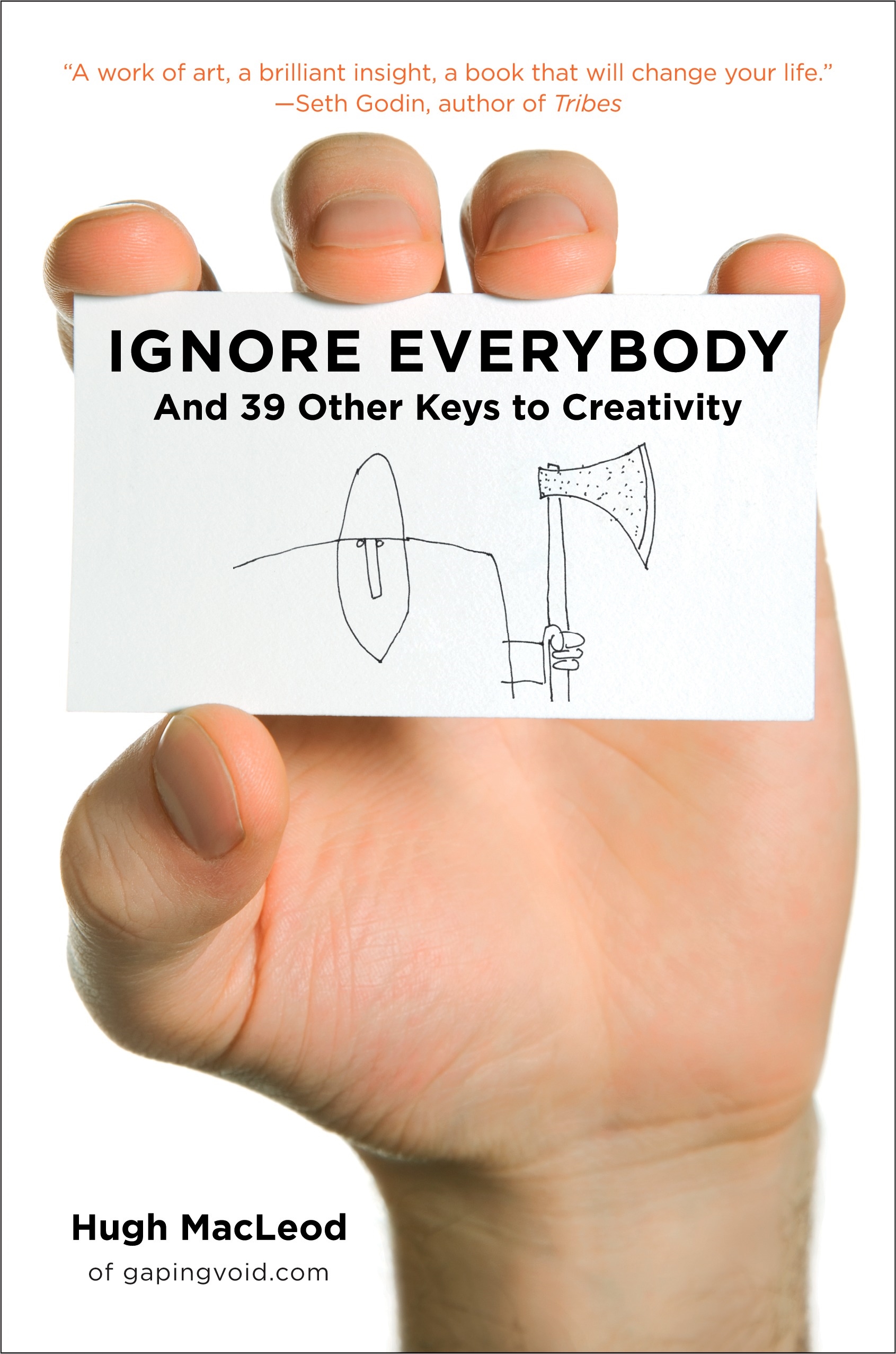
Today, I spoke with Hugh MacLeod, who is a cartoonist and the author of Ignore Everybody.  In this interview, Hugh briefly talks about his new book, how he got started drawing on the back of business cards, some creativity tips and how to inspire people with your ideas.

Hugh, can you explain the title of your book, “Ignore Everybody”?

I believe that nobody can tell you whether you’re idea is any good or not, especially in the beginning. All you can do is soldier on alone…. ignoring everybody.

What got you started drawing on the back of business cards and how did you turn it into a business?

I was sitting at a bar one day, and realized that I had forgotten to bring along my sketchbook. So I grabbed the next best ting available- some business cards. The rest is history…

A lot of people think that if you build something, people will just come. Why is this false?
It’s not always false. It’s not always true, either. But one should be prepared for either outcome.

What are your top three tips for being more creative in all that we do?

Three tips? Three nouns: Talent, discipline and stamina. Especially discipline and stamina.

How do we inspire other people with our ideas?

By executing on them. The more unlikely it is to succeed at the beginning, the more adversity that is overcome in the process, the greater the triumph, the more people who will be inspired.

—-

Hugh MacLeod is the author of Ignore Everybody: and 39 Other Keys to Creativity.  He is a cartoonist and professional blogger, known for his ideas about how “Web 2.0” affects advertising and marketing. After a decade of working as an advertising copywriter, Hugh started blogging at gapingvoid.com in 2001. He first started off just publishing his cartoons, but as time wore on he started blogging about his other main interest i.e. marketing. Since mid-2006 Hugh’s main occupation has been helping a small South African winery, Stormhoek “rise above the clutter” in the wine market by using Web 2.0 tools to get the word out.


Picture of Dan Schawbel

Dan Schawbel

Dan Schawbel is the Managing Partner of Millennial Branding, a Gen Y research and consulting firm. He is the New York Times and Wall Street Journal bestselling author of Promote Yourself: The New Rules For Career Success (St. Martin’s Press) and the #1 international bestselling book, Me 2.0: 4 Steps to Building Your Future (Kaplan Publishing), which combined have been translated into 15 languages.

TRENDING AROUND THE WEB

What a mathematics teacher learned about the logic of sentences

What a mathematics teacher learned about the logic of sentences

Global English Editing

The difference between a voice and a style — and why editors notice it immediately

The difference between a voice and a style — and why editors notice it immediately

Global English Editing

New York’s legislature has passed a bill requiring both AI disclosure and human review of AI-assisted news — the first time a government has tried to legally define what a human editor’s presence requires

New York’s legislature has passed a bill requiring both AI disclosure and human review of AI-assisted news — the first time a government has tried to legally define what a human editor’s presence requires

The Blog Herald

Thought by Epictetus: “Men are disturbed not by things, but by the views which they take of things” — a sentence written nearly two thousand years ago that most people only discover they’ve been living in reverse

Thought by Epictetus: “Men are disturbed not by things, but by the views which they take of things” — a sentence written nearly two thousand years ago that most people only discover they’ve been living in reverse

The Vessel

The platforms that built their early growth on being tools for writers and creators eventually became systems that extracted value from that writing and returned less of it over time — and the writers who noticed this earliest were the ones who got called paranoid

The platforms that built their early growth on being tools for writers and creators eventually became systems that extracted value from that writing and returned less of it over time — and the writers who noticed this earliest were the ones who got called paranoid

The Blog Herald

For decades psychologists measured the good life two ways, as happiness and as meaning, and then kept meeting people who wouldn’t trade their most disorienting years, the move that failed, the year everything changed — for all the calm in the world

For decades psychologists measured the good life two ways, as happiness and as meaning, and then kept meeting people who wouldn’t trade their most disorienting years, the move that failed, the year everything changed — for all the calm in the world

The Vessel