Today, I spoke to Anya Kamenetz, who is a financial speaker, bestselling author of Generation Debt, a Yahoo! Finance columnist, and a staff writer for Fast Company Magazine. Her latest book is called DIY U: Edupunks, Edupreneurs, and the Coming Transformation of Higher Education. In this interview, Anya talks about the issues with the higher education system, things that needed to be changed now, why people don’t need a college degree to succeed, and more.
What issues do you see with our current education system?
It is caught in an unsustainable cost spiral–tuition is increasing at twice the rate of inflation. Demand is far outpacing supply as people worldwide clamor for more education–enrollment is up 53% worldwide over the last decade, and UNESCO estimates there’s no physical way to build enough campuses, fast enough, to meet demand for the next decade. And finally, the system is highly leaky and unproductive, with attrition rates approaching 50% at US colleges.
If you were the dean of all higher education, what would you change?
For historic reasons, higher ed is organized around the needs and interests of institutions. Over centuries these have been created to serve national, state, regional, religious, political, cultural, and other special interests, and once created, they aim to serve their own interests, which means growing bureaucratic inertia. The most important shift that needs to happen is changing focus from the institution and its needs, to the individual learner and her needs. This means you should be able to choose when, where, and how you learn best. You should be able to shop around for various components like classes and internships at the best available prices. And you should be able to take with you your portfolio of accomplishments and credit for experience from setting to setting throughout your life.
Do you think everyone needs a college degree to succeed? Who shouldn’t waste four years in school?
Nobody should *waste* any of their time in school–if you are inclined to do so and you don’t come from money, that’s an easy indication that you shouldn’t be there.

Less than one-third of the jobs in our economy even nominally require a college degree, and there are many highly successful people–particularly in the creative, tech, and entrepreneurial worlds–who manage to succeed in college-“required” fields without the degree. What matters is a passion, skills and the ability to demonstrate them, and connection to a community of professionals, peers and mentors, engaged in the work you want to do. A degree is just one means to those ends.
What inspired you to write both “Generation Debt” and “DIY U”?
I wrote Generation Debt as a young college graduate in post-9/11 New York City observing that many of my peers were struggling to stay afloat and that the deal offered to our generation –go to college, get a good job–was not panning out the way it had for previous generations.
DIY U emerged from my experiences post-Generation Debt talking to hundreds more students on campuses around the country. I realized that because of the cost spiral, more student aid would not necessarily make college more affordable, and I heard that students had other 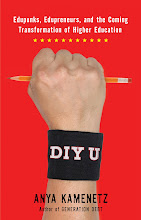 concerns about the value and relevance of their education. Luckily at the same time I was covering tech and innovation for Fast Company, and as a print journalist I was witnessing the massive upheavals in my own industry. I started to connect the dots that higher education was, like other information industries, ripe for disruptive innovation.
One thing I struggle with is how a college education is costing 6% more each year, yet the nation is poorer each year. How will this all pan out and what can be done to fix it?
When a situation is unsustainable, it can’t go on. Higher ed is up against the wall right now . The one thing that can change quickly is the attitudes of students and their families who start to ask tougher questions and demand that institutions change with the times.
——–
Anya Kamenetz, a financial speaker, is the rare expert on youth issues who actually belongs to the demographic she chronicles. Since graduating from Yale University in 2002, Kamenetz has been a New York City-based freelance writer. In 2004, the Village Voice nominated her for a Pulitzer Prize in feature writing for her work on the series Generation Debt: The New Economics of Being Young. In January 2005, the series became a biweekly column and Kamenetz became one of the youngest columnists in the paper’s history. Today, she reaches millions with her “Generation Debt” online column as a personal finance expert for Yahoo! Finance. She is also a staff writer for Fast Company magazine. Currently, she is at work on a new book, to be published in April 2010. DIY U: Edupunks, Edupreneurs, and the Coming Transformation of Higher Education will shed light on the future of education, and how technological and experimental innovations can break the cycle of rising costs and set education free.