A brand name is destroyed
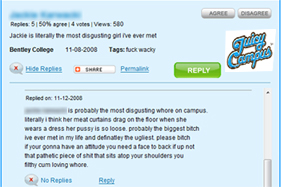
I went back to visit some college friends a few days ago and my friend introduced me to this decent looking girl. She was very friendly and cool. About an hour into the conversation, my good friend pulled me aside and told me (word of mouth) of her bad reputation as a “slut.” By hearing this, I looked at this girl in a different way because WOM influenced my perception of her.
It turns out that you can visually see this girls reputation eroding online, through a very harsh website called Juicy Campus, which reveals college gossip and students login anonymously. I observed the various comments left by men at Bentley and then some of her friends who left opposing comments to balance off the argument. The end result is that online reputation catastrophe was established in reality, but now is known by a good portion of the student body because of this website. This is WOM 2.0!
What is WOM?
Word of mouth (WOM) is how messages travel from one person to the next, creating a viral effect. When it comes to marketing, you want people to say good things about your brand because their endorsement counts more than your own. When something is considered “buzz-worthy,” it means that people are more likely to share it with friends and their friends and so on. This is very important for brands because they get viewed by more people, with no additional cost.
[youtube=http://www.youtube.com/watch?v=cb3WkNhAlpU]
WOM research
- 25 million US adults regularly share advice on products or services online (eMarketer).
- 94.1% of US adults regularly or occasionally give advice to others about products or services (eMarketer).
- The average tech embracing youth has 94 phone numbers in his or her mobile phone, has 78 people on an instant messenger buddy list, and has 86 people in his or her social community (Circuits of Cool/Digital Playground Study).
- 83% of tech embracing youth visit a majority of websites because of links sent from friends (Circuits of Cool/Digital Playground Study).
- 59% of college students pick word of mouth as their preferred method for learning about new products and services (eMarketer).
WOM 1.0 vs 2.0
To get a full glimpse of how WOM has changed, I’m going to compare it to how the web has changed, as well as our brands.
The 1.0 version was very rigid, strict and confined.
- Web 1.0 was an web filled with static pages.
- Me 1.0 was when you had to hide behind your corporation.
- WOM 1.0 was when it was hard to trace conversations because they were spoken in real world environments, mostly behind your back.
The 2.0 version is very open, loud and scattered.
- Web 2.0 is the rise of two way communication online.
- Me 2.0 is when you are able to stand in front of your corporation.
- WOM 2.0 is where conversations are brought online and they are observable through blogs, social networks, etc.
How word of mouth can spread
Let’s say that a random blogger makes fun of you in a post. Even if he or she had five RSS subscribers, one of them can then Tweet the article. From that single Tweet, someone bookmarks it on del.icio.us. That bookmark gets Stumbled 100 times and then winds up on Digg. It finally makes the Digg homepage and someone on YouTube makes a video about it, which winds up on the homepage, in front of thousands of eyes. The New York Times decides to run a story on it.
What you can do about it
1. Monitor: Use reputation management tools in order to find out what people are saying about you online. Try your hardest to stop bad press before it travels.
2. Self-awareness: You should start being more aware of how you act in an online and offline setting. If you can pay more attention to how you’re responding to others, less negative and more positive WOM should spread.
3. Produce: Instead of being just a content consumer, be a producer. Generate content that people will want to talk about, including video, audio or written posts.
Welcome to WOM 2.0. Can you handle it?