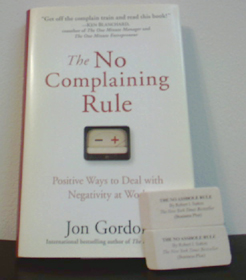
Two presents came in the mail recently (pictured below). One was “The No Complaining Rule” by Jon Gordon and the other was a combination of two erasers, which was part of Robert Sutton’s promotion for his book, “The No Asshole Rule.” I always enjoy gifts and great reads that are related to workplace issues, such as employee loyalty, retention, recruitment, management and leadership. These two books are some of the best.
Here are the two rules:
No complaining!
There is way too much negativity in the workplace today and it creates a sense of poor morale within corporations. This negativity ends up costing companies billions of dollars and impacts the bottom line because, as we always speak about, personal brands have a direct impact on the corporate brand and visa versa. This impact hurts collaborative teams, their productivity and their mental health.
Gordon showcases a company that uses his “No Complaining Rule” technique in an engaging way that will captivate you as readers. It is a practical strategy to develop positive leaders, organizations and teams. Why invest so much of your time in complaining about work, when you can start to make things right today. As with anything else, it starts with you. Quit complaining and start breathing positive energy into your work environment.
No assholes!
Excuse my language, but yes, that is the name of the book and for good reason. Have you ever had an asshole manager, who doesn’t treat you right? This book is very honest and true to the modern workplace, which is plagued with assholes. Sutton, who is a professor at Stanford University, argues that assholes poison the work environment. He defines an asshole as a person “who deliberately makes co-workers feel bad about themselves and who focus their aggression on the less powerful.”
What started as an article in the Harvard Business Review became a book kept on many employees desks, reminding managers to “chill out.” This is a survival guide for people at work, who are around assholes and want to do something about it.
About the authors
Jon Gordon is a speaker, consultant, and author of the international bestseller The Energy Bus: 10 Rules to Fuel Your Life, Work, and Team with Positive Energy, which has inspired readers the world over. He and his books have been featured on CNN and on NBC’s Today show, and in Forbes, Fast Company, O: The Oprah Magazine, the Wall Street Journal, and the New York Times. Clients such as the Jacksonville Jaguars, the PGA Tour, Northwestern Mutual, JPMorgan Chase, and Publix Supermarkets also call on Jon to get their team “on the bus” and moving in the right direction. For more information about Jon, please visit www.JonGordon.com.
Robert Sutton is Professor of Management Science and Engineering in the Stanford Engineering School, where he is Co-Director of the Center for Work, Technology, an active member of the Stanford Technology Ventures Program, and a co-founder of the new Hasso Plattner Institute of Design. Sutton is the author of “Weird Ideas That Work: 11 ½ Practices for Promoting, Managing, and Sustaining Innovation” and co-author (with Jeffrey Pfeffer) of “The Knowing-Doing Gap: How Smart Firms Turn Knowledge Into Action.” He blogs and writes for BusinessWeek as well.