Craft a Consistent Brand Image Across All Social Networks

This week has already been amazing because I’ve finally gotten to posts that were in the queue for months. My last few posts have helped you understand the importance of reputation management to secure your brand and how to leverage various media types to get your message across. Today, I want to talk about how to craft a consistent brand image across all social networks. This is timely because I switched my profile picture and avatar across all my networks within the past 24 hours, which you’ve probably already noticed.
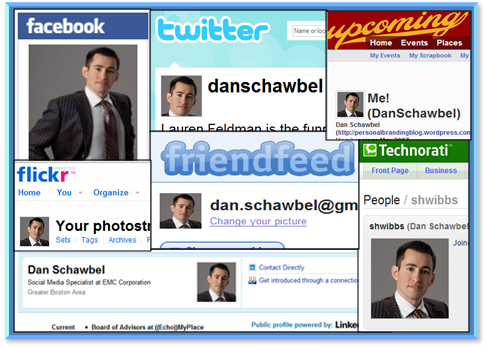
Consistency Social Networks

You need 2 types of pictures

1) Avatar: An avatar is possibly the most accepted image on the internet right now. It is specifically geared towards social networks, such as Flickr, Technorati, friendfeed, LinkedIn, upcoming, and Twitter. If you view the above image you will see that it is an accepted format and if you use the same avatar for each, it will resonate with others and people will start to identify you as brand you. An avatar is 128×128 pixels if you want to create one. I use Adobe Photoshop to edit the pictures down to this size, but you can use other program such as Microsoft Paint or the Apple equivalent.

2) Profile or Headshot: Facebook and MySpace don’t promote avatars. They emphasize full pictures of people, which means you might not have to trim or edit your photograph to be included. If you have a photographer take your shots like I did, then you will be able to submit them to the media upon request. The media looks for shots of 300 dpi quality. If you are building a press kit or package, you can include these pictures, or you can place them in your blog profile page. The full image is important for giving your audience a better idea of what you look like.

Updates and consistency

As you grow, your eBrand must grow at the same rate, which means, you need to get newer pictures to include. My last picture made me look like I was 18 again, which I’m not. I’m 24 right now and I wanted to get an updated picture for my book and materials. The second I received the pictures, I updated all many sources as possible, so that people understood the picture was changed and weren’t confused by different pictures that represented me differently.

The key here is consistency and honestly, it’s very hard online, especially with press articles, contributed articles and blog posts that have my old picture. You do your best and you update what you have control of, which is typically your own websites.

Are you in need of a personal brand makeover? What is your strategy?

Picture of Dan Schawbel

Dan Schawbel

Dan Schawbel is the Managing Partner of Millennial Branding, a Gen Y research and consulting firm. He is the New York Times and Wall Street Journal bestselling author of Promote Yourself: The New Rules For Career Success (St. Martin’s Press) and the #1 international bestselling book, Me 2.0: 4 Steps to Building Your Future (Kaplan Publishing), which combined have been translated into 15 languages.

TRENDING AROUND THE WEB

Ask a woman in her sixties what she wants to do with a free Saturday, and many go quiet, not for lack of preferences, but because decades of quietly editing their own desires to match someone else’s have left them without an easy way back to what was theirs to begin with.

Ask a woman in her sixties what she wants to do with a free Saturday, and many go quiet, not for lack of preferences, but because decades of quietly editing their own desires to match someone else’s have left them without an easy way back to what was theirs to begin with.

Global English Editing

Economists studying happiness data from more than 130 countries found that well-being typically bottoms out around age 47 or 48, then rises again through later adulthood — meaning the average happiness curve often improves well beyond midlife rather than continuing to decline with age.

Economists studying happiness data from more than 130 countries found that well-being typically bottoms out around age 47 or 48, then rises again through later adulthood — meaning the average happiness curve often improves well beyond midlife rather than continuing to decline with age.

Global English Editing

Psychologists at the University of Texas sent strangers to size up 177 bedrooms and offices using nothing but the objects left behind, and the tidiest, most deliberately arranged rooms almost always turned out to belong to the most conscientious person who lived or worked there.

Psychologists at the University of Texas sent strangers to size up 177 bedrooms and offices using nothing but the objects left behind, and the tidiest, most deliberately arranged rooms almost always turned out to belong to the most conscientious person who lived or worked there.

Global English Editing

9 cities that inspired the world’s most famous novels

9 cities that inspired the world’s most famous novels

Global English Editing

Stanford researchers who tracked how people’s social circles change with age found that older adults don’t lose the ability to make friends — they simply get pickier, deliberately keeping fewer relationships that feel meaningful and letting the rest go, a shift linked to higher emotional well-being, not less

Stanford researchers who tracked how people’s social circles change with age found that older adults don’t lose the ability to make friends — they simply get pickier, deliberately keeping fewer relationships that feel meaningful and letting the rest go, a shift linked to higher emotional well-being, not less

Global English Editing

The Night Is Not a Product: On Listening to Dreams Before Turning Them Into Content

The Night Is Not a Product: On Listening to Dreams Before Turning Them Into Content

The Vessel