After all the hoopla, does Google’s latest social launch change much for your brand?
Last week, Google launched Google+, which some people were calling Google’s long-rumored social network for competing with Facebook.
We already know that done properly, using Facebook can build your brand. So what about Google+?
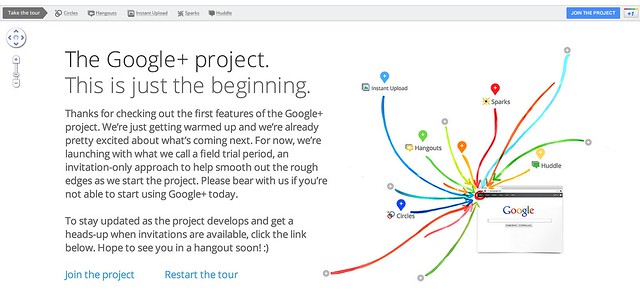
Right now, Google+ has 5 main features: Circles, Sparks, Hangouts, Huddle and Instant Upload.
 Circles
What it is: a way for categorizing your contacts, making it easier to share with the right people and avoid sharing with the wrong ones.
Similar to: this is a feature that doesn’t yet exist in Facebook or Twitter or LinkedIn.
Personal branding usefulness: If you organize your personal & professional contacts properly in the right Circles, you’ll more likely share appropriate content with each Circle, and more often, growing your brand as an authoritative source IF you regularly share quality content.
Sparks
What it is: news feeds about specific topics
Similar to: Twitter Lists, except that it’s a stream of information based on Google, and not a fixed list of sources
Personal branding usefulness: if you choose your Sparks well, they’ll act as a good source of sharing for your Circles. It would also be meaningful if your Google Profile publicly showed your Sparks of interest, but I haven’t seen that yet.
Hangouts
What it is: video conference with up to 10 people.
Similar to: a paid Skype Pro feature i.e. that doesn’t yet exist in Facebook or Twitter or LinkedIn.
Personal branding usefulness: a great way for holding small meetings such as for brainstorming with or coaching (potential) clients, or just networking.
Huddle
What it is: smartphone IM chat
Similar to: Facebook chat with friends
Personal branding usefulness: designed to be used with people you already know and are in touch with regularly i.e. your friends, it has minimal brand-boosting power.
Instant Upload
What it is: quick smartphone photo sharing
Similar to: at its most basic, any decent social network smartphone app should allow you to do something like this.
Personal branding usefulness: this is basically a specific case of something – photos – to easily share with your Circles. If you share something valuable, your Circles will love you for it.
The new Google Profile
With the rollout of Google+, Google has also redesigned your Google Profile – here’s mine – to show your personal stream (read: news feed), once you have one.
What is is: your old Google Profile, with a new look.
Similar to: your Facebook profile from a few years ago, with much less features
Personal branding usefulness: as the hub of your Google+ presence, what you expose on this profile will have the most impact on growing your brand through people who discover the page.
Like with any major social network, profiles have vanity urls. If you know someone’s Gmail address (or feel lucky), you can deduce their Google vanity url of http://profiles.google.com/[Gmail User]
However by default the vanity url isn’t public, so unless you’ve made it so, your vanity url will redirect to an impossible-to-deduce url like https://plus.google.com/113581131899732146840/about?tab=Xh.
Conclusion: is Google+ a personal brand builder?
A lot of social media is about sharing valuable information, and Google+ makes it easy to do, but mainly with people who already know you.
In other words, at launch, Google+ seems to be a good tool for strengthening existing relationships and less for creating new ones, which is how you grow your brand.
Use Google+ for its unique features and easy sharing, but it won’t replace any of your other personal brand building tools right now.
Author:
Jacob Share, a job search expert, is the creator of JobMob, one of the biggest blogs in the world about finding jobs. Follow him on Twitter for job search tips and humor.