Recently, I spoke with Andy Beal about reputation management. In terms of the personal branding process, reputation management falls into the “maintain” bucket. First, you discover your brand (what you represent, are passionate about, etc), then you create a brand online, communicate it to your audience through personal PR and then maintain your reputation. Andy, is not only a consultant, speaker, business owner, blogger and author, but one of the judges for the 2008 Personal Brand Awards. He blogs at Marketing Pilgrim, which is a top 10 blog by AdAge, out of over 600 (I’m #71 right now). He’s also one of the most sought after speakers for the search industry and one of the more respected internet marketers by his peers, such as Shoemoney and Neil Patel. Andy even found the time to write an entire book dedicated to reputation management called “Radically Transparent,” while starting his own company called Trackur.
—–
People have the choice whether they engage in eBranding. True or false? Why?
Andy: Of course they have a choice. But, the real question is, do people realize they have an eBrand? Everyone has a brand–especially online–they just need to decide whether they wish to play a part in its development.
If you’re in a situation where your reputation is damaged by another media source, either blog or traditional media, how do you react?
Andy: It depends on whether the damage is the results of a legitimate criticism, or incorrect (and maybe defamatory) attack.
If you are the victim of a legitimate crisis–for example, a web designer that didn’t deliver a web site–then you should follow the seven step plan we share in Radically Transparent.
- Check the facts
- Determine the impact
- Bring together trusted counsel
- Understand your detractor
- Decide on the appropriate response
- Host the conversation
- Continue to monitor
You can distill it down to just three words. Sincerity, Transparency, and Consistency. Be sincere in your apology. Be transparent in explaining how you are resolving the situation. Then, be consistent in your future actions.
If you’re the victim of a defamatory attack, the process is very much the same. The difference is that you can afford to be a little more insistent in your communication. I.e. you can bring on side your legal counsel to ensure the incorrect information is removed.
What are a few ways you can maintain a strong presence in Google and how can you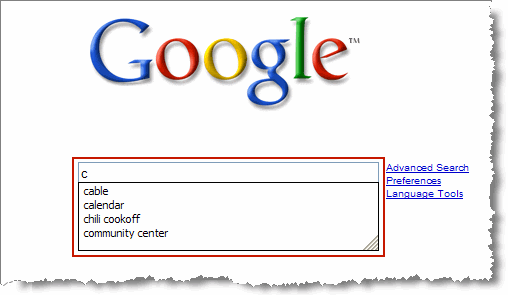 counteract negative search results when they appear?
Andy: The best defense is a strong offense. With your Google reputation, you need to make plans now. It’s much easier to build positive content for Google now–while you’re not under attack–than to wait until the negative results appear.
Start with the registration of a domain name that matches your brand–your personal or business brand–and publish a blog to it. You can also create profiles at popular social networks such as Flickr, Facebook, and LinkedIn–all of which rank well in Google.
How does one become synonymous with a phrase? For instance, when people think of personal branding, my name is top-of-mind and when they think of Andy Beal, they think of Marketing Pilgrim.
Andy: Lots of repetition until they get it right! 🙂
I chose Marketing Pilgrim for my blog because I felt it matched my ongoing journey to find the latest internet marketing trends. I’ve been blessed that enough people enjoy reading what I have to say–and it didn’t hurt to refer to myself as the “Pilgrim” now and then. 😉
How were you able to start a new company (Trackur), co-author a book, blog, consult and speak in the past few months? Can you explain how each supported one another?
Andy: If my ambitions ruled my life, I’d have about twenty different projects going on at any one time. It’s very hard for me to switch off. Instead, I forced myself to pick just four channels to focus on for the majority of 2008: consulting, blogging, speaking, and Trackur.
For the most part, each of the channels share synergy with each other. This helps keep my efforts focused and keeps me a little more efficient in my promotion. For example, when I speak at an event, I can discuss online reputation management and tie it back to my consulting, book, and Trackur.
Can you share any email best practices? How do people brand themselves through email and what impact does each email have?
Andy: My best advice is to not get sloppy with email. It can be very easy to fall into instant messenger or Twitter “speak” but you should realize that your emails say a lot about your brand.
Also, for reputation management purposes, always assume your email will be made public at some point. That assumption will help you maintain the correct tone in your emails.
How did you discover your personal brand and what strategies got you to where you are today?
Andy: I realized that personal branding was at least as important as company branding. My company may change, but I’ll always be Andy Beal.
If you want to build a strong brand, it’s not enough to simply become great at what you do. You have to let others know too! While it can be very difficult to set aside modesty, if you don’t brag about your accomplishments, who will?
Writing articles and speaking at industry events are two of the channels that really helped with my personal branding. Once blogging came along, that made it even easier.
If you have a deeper interest on how to position yourself on Google or simply manage your eBrand, Andy’s new book is a great resource for you.