

Today, I spoke with Scott E. Page, who is a professor at Michigan and is extremely knowledgeable when it comes to diversity. For the benefit of my blog readers, I asked Scott a lot of questions on how diversity in teams is crucial to building a strong personal brand. One of the main conclusions you’ll see is that if you supplement your skills with a diverse team, you will be able to solve problems faster and smarter.
Scott, what is the real power in diversity?
I think everyone recognizes that solving hard problems and anticipating the future in a complex world requires enormous cognitive capacity. Given a cognitive task, we have two options:
- we can hope one person has the ability to accomplish it
- we can choose to rely on a team or a collection of people
As the task becomes harder, the team or collection becomes the better choice. Why? Diversity. Each person brings a unique set of tools, representations, and heuristics to bear on a problem. The value of diversity should be obvious: if you have cognitive diverse people, you have more tools to bring to bear. To see diversity as having pragmatic benefits much in the same way that we see ability as useful.
What are the pitfalls of having a small business, where everyone has similar skills and personalities?
Common personalities aren’t necessarily bad. They can allow people to feel comfortable and to interact easily. The problem with skill homogeneity though is crucial. If all the employees went to the same school, had the same major, belong to the same identity group, etc.. they’re likely to see the world the same way and, though that helps with communication, it means they’ll have common blind spots and get stuck on the same suboptimal solutions. Rarely will people say “I wouldn’t have thought of that.” If you’re not saying that at work, your firm isn’t diverse enough.
Why can teams of people find better solutions than individuals working independently?
A team brings multiple ways of seeing a problem. If one person gets stuck, another person can often see a path to a solution. Further, different people know different tricks, different rules of thumb. This enables diverse teams to locate better solutions and to locate them faster. There’s a ton of evidence that diverse teams produce more solutions. This stems from these differences in seeing and thinking.
Personal brands don’t scale but corporations do. Do you believe this statement to be correct? Why?
I’m not sure. It’s an interesting question and something I’ll chew on. I’ll have to ask some people with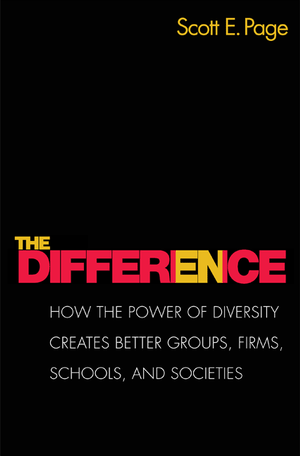 different experiences than me and see what they think. Twenty years ago, I would have agreed but now I think that Oprah has scaled.
Would you rather have someone with an enormous IQ or a diverse group of people working together? Should individuality and creativity be celebrated in the workplace?
It depends on the problem. First, I’m not a huge fan of IQ as a measure, but here’s a brief take. If the task is conjunctive — if everything has to be connected in a coherent whole — if I need someone to write a novel or to write advertising copy — I might go with the solitary genius.
If the task can be broken into parts to some extent, if solutions to one part of the problem — let’s saying making the engine more efficient — can be done independently of other parts — let’s say designing the dashboard, then give me the team any day.
——
Scott E. Page is professor of complex systems, political science and economics at the University of Michigan. He also is a senior research scientist at Michigan’s Institute for Social Research and associate director of the Center for the Study of Complex Systems.
He researches how diversity improves performance and decision making, when ‘diversity’ means what we look like on the outside, rather than what we look like within—the tools and abilities that make each of us unique. He is the author of The Difference: How the Power of Diversity Creates Better Groups, Firms, Schools, and Societies, about how we think in groups and why collective wisdom works.






