

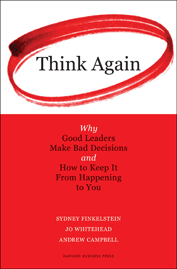
Today, I spoke with Sydney Finkelstein, who is a professor at the Tuck School of Business at Dartmouth and the author of Think Again. Sydney has researched and analyzed why executives have made poor decisions and reveals some of that information today for us. He examines why people make poor decisions over and over again and how to prevent future mishaps.
Why do decision-makers sometimes think they’re right when they are really wrong?
“Our brains are wired in such a way that most of the time our decisions are based more on emotions than rational thinking.”
When emotions dominate, our subconscious takes over and we quickly reach a conclusion, usually without even knowing how it happened. The result is we fully believe we’ve got it right when in fact our emotional biases have steered in the wrong direction.
From your research, what are 3 facts that point to leaders making mistakes?
Leaders are more likely to make mistakes when they are lone rangers, operating on their own rather than surrounding themselves with talented people. They are more likely to fail when they insist on relying on solutions to past problems that worked for them, regardless of whether those past solutions are the right ones in the present situation. And leaders are more likely to make mistakes when refuse to learn from past mistakes.
Why do people keep believing they have made the right choice, even when disastrous result stare them in the face?
It is very difficult to admit you’ve done something wrong. Sure, some people are more adaptable and open-minded than others, but the power of the choices we’ve already made is enormous. We will tend to look for confirming evidence, and disregard or deny other viewpoints or data that challenge our choices we’ve already made. You can see this when people quickly point out that others are wrong, and they are right, regardless of the facts in place. So, we have a natural tendency to believe we are going in the right direction, and it sometimes takes an enormous amount of information to change our views. This was true in Iraq, and it has been true in the automobile industry for decades.
Why do we try and take shortcuts in life, when the long road can be healthier and help us achieve even more success?
Who has time to think through every little decision we need to make? Our brains are expert at reaching quick conclusions, at using heuristics to work things out, and taking shortcuts. That is why we do it, but the risks are large when there are warning signs in place ahead of time.
How can we identify that we are at risk for a major mistake/issue that can hurt our business or our health?
These warning signs are the key to identifying our vulnerability to making big mistakes. They include having an experience base that has been successful, but may not be well-suited to the present problem. For example, Bank of America acquired Merrill Lynch at the beginning of 2009, using the same logic that had been successful in making deals beforehand. The global financial crisis, however, has made this past experience obsolete, and dangerous to follow.
A second warning sign is when we are attached to a person, place, or thing that might color our thinking. For example, as people lose their jobs in this downturn, where are they looking for work? Most people will focus on the same industry, or functional area, they come from, even if the job opportunities are elsewhere. Our attachment to certain ways and places of working can limit our opportunities.
——-
Sydney Finkelstein is the Steven Roth Professor of Management at the Tuck School of Business at Dartmouth. Sydney is the author of Think Again: Why Good Leaders Make Bad Decisions and How to Keep it From Happeining to You. He also has experience working with executives at Northwestern, Wharton, Duke, Bocconi, London Business School, Australian Graduate School of Management, Melbourne Business School, Hanoi School of Business, the Chalmers School (Sweden) and the Helsinki School of Economics. He teaches executive education at the Tuck School, where he serves as the Faculty Director of the flagship Tuck Executive Program. Professor Finkelstein has published 11 books and over 60 articles, including the #1 bestseller in the U.S. and Japan, Why Smart Executives Fail.






