Today, I spoke to Dennis Crowley, who is the co-founder of foursquare and previously founded dodgeball.com, one of the first mobile social services in the US, which was acquired by Google in 2005. In this interview, we go over his latest and very popular startup called foursquare, as well as talk entrepreneurship, teaching and Family Feud!
What inspired you to start foursquare after you had sold dodgeball.com to Google?
We decided to build foursquare after Google announced they were going to shut down foursquare... we still had a few hundred close friends that were using it and we wanted to build a service they could use as a replacement. The game mechanics are heavily inspired by things like Nike+ and the “Tips” are inspired by a trip I took through Scandinavia in which I completely crowdsourced by itinerary 🙂
As an entrepreneur making big waves during an economic shift, what recommendations do you have to other entrepreneurs who are looking to do the same?

Don’t let people tell you your ideas are stupid – if you’re really passionate about something, find a way to build it.
And build build build.. if you’re not a coder, find someone that can help…. build early and iterate often and help your users guide you towards the best implementation of your ideas.
Aside from being an entrepreneur, you’re also a professor. How do you manage both and how do they both support your personal brand?
Ha, I haven’t taught in about a year since I’ve been so swamped w/ foursquare stuff. Maybe next semester tho! While it takes an incredible amount of time to prepare and teach a class, its incredibly inspiring to work with amazing students.
Foursquare is starting to take off. What challenges and opportunities are you starting to see with growing this company?
There’s a lot to keep up with! We’re a small team and keeping the product growing while hiring the right folks can be difficult. The space is also heating up and we’re expecting everyone from Facebook to Twitter start to do interesting things in the geo space.
What real business value does foursquare have? Have any big companies take advantage of it yet?
Not yet, but we’re having conversations with all sorts of folks – everything from big brands to mom-and-pop coffee shops. Look for some of this early next year!
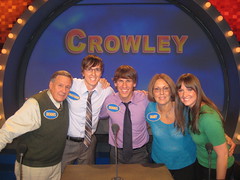
How did you get on Family Feud and why did you include it as part of your professional bio?
Ha, playing (and winning!) on the Feud was one of our family’s greatest accomplishments! It’s something my brother’s been wanting to do for 20 years and after all the time the pieces game together and we found a way onto the show. And why not include it on my bio? 🙂 To be, it’s a much greater (and more interesting) accomplishment than bringing dodgeball to Google 🙂
——
Dennis Crowley is the co-founder of foursquare, a service that mixes social, locative and gaming elements to encourage people explore the cities in which they live. Previously, Dennis founded dodgeball.com, one of the first mobile social services in the US, which was acquired by Google in 2005. He has been named one of the “Top 35 Innovators Under 35” by MIT’s Technology Review magazine (2005) and has won the “Fast Money” bonus round on the TV game show Family Feud (2009). His work has appeared in The New York Times, The Wall Street Journal, Wired, Time Magazine, Newsweek, MTV, Slashdot and NBC. He is currently an Adjunct Professor at NYU’s Interactive Telecommunications Program. Dennis holds a Master’s degree from New York University’s Interactive Telecommunications Program and a Bachelor’s degree from the Newhouse School at Syracuse University.