

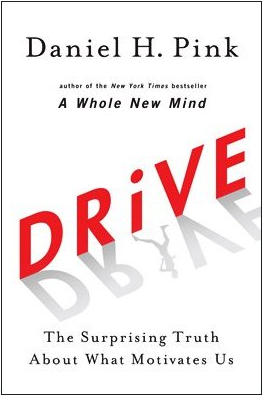
Today, I spoke to Daniel Pink, who is the New York Times bestselling author of A Whole New Mind: Why Right-Brainers Will Rule the Future, and the author of the new book called Drive: The Surprising Truth About What Motivates Us, which arrives in late December. This is one of his first interviews before his new book comes out, so we spoke about how he was influenced to write it, what his thesis is, and then dove deep into what drives people.
What influenced you to write “Drive” and how does it connect with the message in your previous books?
I actually wrote a little about motivation in both FREE AGENT NATION and in JOHNNY BUNKO. But it was the central idea in A WHOLE NEW MIND — that we’re moving to a world where creative, conceptual, empathic abilities matter most –– that really got me thinking. How do people develop those sorts of abilities? That question led me to the science motivation — and the answers I found surprised me.
From your research, what are the common factors that motivate people in the workplace? Why do old routines not work anymore?
First you have to have the “baseline rewards” in place — a decent salary, some benefits, an ok work environment. Without those, there will be no motivation at all. But beyond that, the main insight from 40 years of behavioral science is that what I call “If-then” motivators — “If you do this, then you’ll get that” — can be effective, but that they work in only a surprisingly narrow band of circumstances. And for creative, conceptual tasks, they rarely work and often do harm — because they narrow our focus so severely. Since more of us are doing that sort of work, the motivational operating system we have in place needs an upgrade. Badly.
How does intrinsic motivation work on the job, at home, and in ourselves?
The key is to understand that we have several drives.

- Drive #1: We have a biological drive: we eat to sate our hunger, drink to slake our thirst, and so on. That’s part of being human, but that’s not all we are.
- Drive #2: To seek rewards and avoid punishments in our environment. But that’s not all we are either.
- Drive #3: To direct our own lives, to get better at things that matter, and to connect to something larger than ourselves. It’s that drive — what some think of as intrinsic motivation — that’s essential to high performance and even personal fulfillment.
Are any companies currently leading the way with this new form of motivation?
Sure. One of my favorites is Atlassian, an Australian software company. Once a quarter, they do something very cool. For 24 hours, they let their developers can work on anything they want, any way they want, with whomever they want — and then show the results to the rest of the company. That one day of intense autonomy — and autonomy is critical to genuine motivation — has produced a whole array of software fixes and ideas for new software that might not have emerged otherwise.
In terms of your career and brand, how does this new book support your overall mission?
I’m trying help people see what’s going on around them in a new, and more accurate, light — and then use those insights to improve their work and their life just a bit. If DRIVE does that for a few readers, that’s incredibly motivating.
——-
Daniel H. Pink is the New York Times bestselling author of A Whole New Mind: Why Right-Brainers Will Rule the Future, which has been translated into 20 languages. He also authored The Adventures of Johnny Bunko and Free Agent Nation. Dan’s articles on business and technology appear in many publications, including the New York Times, Harvard Business Review, Fast Company, and Wired, where he is a contributing editor. He has provided analysis of business trends on CNN, CNBC, ABC, NPR, and other networks in the U.S. and abroad. He also lectures to corporations, associations, and universities around the world on economic transformation and the new workplace. A free agent himself, Dan held his last real job in the White House, where he served from 1995 to 1997 as chief speechwriter to Vice President Al Gore. His next book is called Drive: The Surprising Truth About What Motivates Us, which arrives in late December. (This is an affiliate link, so we may earn a commission if you buy. It costs you nothing extra.)






