Personal Branding Clam Model of Protection

From time to time, I like to create models for some of my bigger ideas. At the end of last year, I contrived the Octopus Model of Relevancy for personal branding. It states that personal branding is made up of eight different topics, which all surround the head of the octopus (the personal brand).

This model owns an entire chapter in my new book, Me 2.0, because in order to grasp the entire idea surrounding the topic, you need to have working knowledge of everything it touches (each tentacle). All the posts on this blog, as well as in Personal Branding Magazine, use this model as a frame that illustrates what type of content you should expect. I’ll be using a different sea creature for each model, if you’re wondering. 😉

Model introduction

I want to introduce you to another significant model that we’ll be using and referring to moving forward. When I started speaking about personal branding two years ago, my message was about promotion, not just self-promotion, but promotion in general. You also want to promote others, who will reciprocate by promoting you. By promoting both yourself and others, you have more than doubled the amount of visibility and opportunities you will receive as a result. It wasn’t until the past few months, where “protection” became a core component of my speeches and articles.

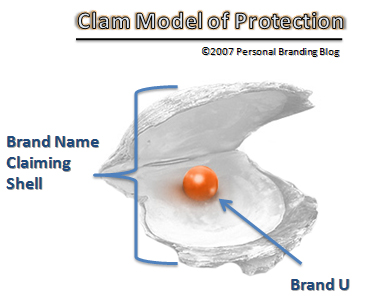
The Clam Model of Protection is born out of the seriousness and immediacy of brand name claiming and security. The model represents the protection your personal brand will receive from identity theft, name duplication and competitive threats, if you aggressively claim your brand name.
How the model works

Every time you claim your brand name, either on a social network, domain, blog, etc, the shell of the clam closes slightly. Your object is to have the clams shell cover your brand name completely. When this occurs, you are protected and have ownership of your brand. As more “name claiming” opportunities open up, so does the shell of the clam, which means you need to ensure those are secure as well.

When using the Clam Model of Protection, you have to constantly monitor the web, by subscribing to blogs, in order to be aware of the next big network that you need to claim your name on. Laggards will lose the opportunity to rank high for their own name and the ease of discovery for people who want to find them. They will also be forced to brand themselves differently than they would have.

Here are some relevant posts on this topic

  • 5 step process for brand name claiming
  • A case study in brand protection
  • Monitor your reputation to protect your brand
  • Domain naming
  • How to ensure you’ve claimed your name on social networks

How open is your brands shell?

Picture of Dan Schawbel

Dan Schawbel

Dan Schawbel is the Managing Partner of Millennial Branding, a Gen Y research and consulting firm. He is the New York Times and Wall Street Journal bestselling author of Promote Yourself: The New Rules For Career Success (St. Martin’s Press) and the #1 international bestselling book, Me 2.0: 4 Steps to Building Your Future (Kaplan Publishing), which combined have been translated into 15 languages.

TRENDING AROUND THE WEB

In May 2005 one male and one female Anolis sagrei lizard were moved from Iron Cay to each of seven hurricane-cleared Bahamian islands; within four years every population had evolved shorter hindlimbs

In May 2005 one male and one female Anolis sagrei lizard were moved from Iron Cay to each of seven hurricane-cleared Bahamian islands; within four years every population had evolved shorter hindlimbs

The Vessel

Chaos will not wait for you to be ready, and that is precisely what it came to teach

Chaos will not wait for you to be ready, and that is precisely what it came to teach

The Vessel

Describing a life as busy and in demand isn’t only a complaint — consumer researchers studying status signaling found that busyness can function as a badge, because people often read a packed schedule as evidence that someone is competent, scarce, and wanted by others.

Describing a life as busy and in demand isn’t only a complaint — consumer researchers studying status signaling found that busyness can function as a badge, because people often read a packed schedule as evidence that someone is competent, scarce, and wanted by others.

Global English Editing

The signs of a hard childhood rarely look dramatic by adulthood, therapists who work with trauma survivors say; more often it is a habit of apologizing before speaking, flinching at a raised voice that was never aimed at them, or checking that everyone else is okay before letting themselves relax.

The signs of a hard childhood rarely look dramatic by adulthood, therapists who work with trauma survivors say; more often it is a habit of apologizing before speaking, flinching at a raised voice that was never aimed at them, or checking that everyone else is okay before letting themselves relax.

Global English Editing

A national survey found that the share of men reporting they have no close friends at all climbed from 3 percent in 1990 to 15 percent by 2021, with the steepest rise showing up right around the age most men leave the workforce

A national survey found that the share of men reporting they have no close friends at all climbed from 3 percent in 1990 to 15 percent by 2021, with the steepest rise showing up right around the age most men leave the workforce

Global English Editing

People who apologize before anyone’s said what’s wrong may be doing more than displaying extra manners — research on parentification has found that children who grow up feeling responsible for a parent’s emotional state can carry that habit of anticipating, managing, and taking responsibility for other people’s feelings into their adult relationships, long after the household that taught it is gone.

People who apologize before anyone’s said what’s wrong may be doing more than displaying extra manners — research on parentification has found that children who grow up feeling responsible for a parent’s emotional state can carry that habit of anticipating, managing, and taking responsibility for other people’s feelings into their adult relationships, long after the household that taught it is gone.

Global English Editing