

I’m starting a three part series on how social media influences the classroom and can provide value to both the professor and student, in an educational setting. To do this, I found two teachers that “get it” and have used blogs for student collaboration and skill development. They also feel it is an innovative and “cool” way to teach. Carinne Weisgerber is an Assistant Professor of Communication at St. Edward’s University in Austin, Texas and Tammy Powley is an Assistant Professor in the Department of English and Modern Languages at Indian River State College.
This series will give you a deeper sense of how the next generation is being groomed!
Why a blog for your students?
Corinne: As a college professor who teaches mostly public relations classes, I’ve become very interested in the way new social media technologies are reshaping the public relations industry. These technologies are reversing our old models of communicating with key stakeholders and are ringing in a new era of two-way communication characterized by conversation and dialogue. Tomorrow’s PR professionals need to understand both the tremendous opportunities and the potential challenges that these social media technologies present to individuals, corporations, government and nonprofit organizations. That’s why I decided to develop a class on Social Media for PR last year.
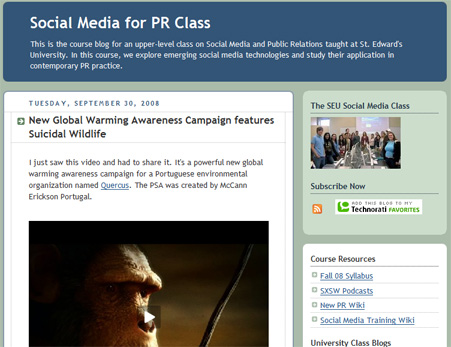
As part of that class I require all of my students to start a blog and post to it twice a week. I also ask them to comment on other blogs at least twice a week to illustrate the importance of participation in the blogosphere. By starting their own blogs, students learn to engage an audience, invite conversation, and respond to criticism. They also learn about the more technical aspects of blogging such as the importance of tagging for search engine optimization, or linking to other blogs.
From a pedagogical standpoint, blogs provide a great new learning tool. They allow students to acquire new media literacy skills and express themselves in ways that go beyond the traditional paper-based term papers we’ve been asking them to write for decades. I’m not advocating that we get rid off term papers, but I do believe that we need to teach students how to articulate arguments using other, newer forms of communication, such as blogs, videos, slideshows, podcasts, etc. These technologies allow students to develop their “public voice” and to learn how to manage their self-presentation in a public forum.
Tammy: Since weblogging is a form of alternative discourse, I think blogs are a good method for showing students that academic writing doesn’t always have to be via the five paragraph theme approach. Also, the technology is free, so it is available to anyone who wants to try it out. Finally, it offers a way for students to learn a few technical skills, which may help them in other areas of their lives (school, work, etc.).
What are the advantages to having a blog for your class from both perspectives (students and teachers)?
Corinne: Having a course blog helps us get noticed and break down the physical walls of our classroom. It has allowed us to invite people outside our classroom to take part in our discussions and serves as a great illustration of the connective power of blogs. As a result of our course blog, we have connected with the authors of both of our textbooks, collaborated with classes from around the world, attracted guest speakers, invited comments from professional and amateur bloggers, received input from PR professionals, video-conferenced with PR firms, and secured new internship offers. Most of the conversations the course blog initiated just wouldn’t have happened only a few years ago. For a student to have the author of his textbook respond to his post about one of the chapters for instance, is something I never even considered a possibility. Yet the blogs allowed it to happen!
Tammy: Weblogs provide a method for creating community among those in the class. Students can post their blog entries and then comment on each others’ blogs, and teachers can also participate via comments.
To be continued…..
The next post will talk about the future of classroom management (Blackboard, etc) and how teachers are using blogs, wiki’s and social networks in the classroom.






