Today, I spoke with Peter Kim, whose had a very inspirational career, starting at Puma, then Forrester Research and now he’s broken away to help lead a new startup. I met Peter at the beginning of this year and we finally got around to this interview. Peter shares some great perspectives on what it takes to build a personal brand within a company and as an entrepreneur. After researching and reporting on social media trends at Forrester, Peter gives us a glimpse on how that stuff matters to our brands today.
Peter, from Puma to Forrester to your own consulting business, what have you taken away from each job that’s helped you move to the next?
I’ve learned to seek out opportunities that that pose new challenges. I’m intellectually curious and think that it’s important tobuild on what you’ve got.
- Puma allowed me to manage both a multi-million Euro P&L and global cross-functional team.
- Forrester helped me connect with C-level executives and top-tier media.
None of these elements are apparent yet in The Dachis Corporation, aka my stealth-mode startup – but I’ll use what I know to help build us into a market leader. Whatever that market may be. Can’t tell you yet.
[youtube=http://ca.youtube.com/watch?v=L6db2mFgERs]
Were you always an entrepreneur wanting to go your separate path? Did you know you wanted to start your own business while happily employed at these companies?
No. My father just retired after 35 years with the same organization; I think earlier generations could be happily employed somewhere based on the promises of the future. However, their future is now and we are seeing promises broken everyday.
For our generation, it’s more important to be “consciously engaged.”
No one should feel so tied to a job that they can’t leave to grow – isn’t that what “at will” employment means, anyway? We need to learn how to take charge of our learning opportunities, 401(k)s, and personal brands – which will lead to different choices along the way.
What originally interested you in the social web? Do you think web 2.0 has gone mainstream and what lies in the future (web 3.0)?
I originally got involved with social media because of a blogger controversy. At the time, I got some people fired up by saying that blogs aren’t a media outlet. I find it ironic that associal media outlets become successful, they start to look likemainstream media and asmainstream media struggles to retain success, it starts to look more likesocial media. Social media is still mainstreaming and will truly arrive once technology infrastructure and industry economics catch up. I don’t know what happens then, but it will be driven by a balance of personal and commercial intent.
What advice can you give to those who are employed at a company and want to escape their day job, in a bad economy? Should they wait?
My advice comes from colleague Doug Rushkoff – get back in the box! Do what you love to do. But how soon is now? It’s whenever you decide it should be. I think I heard that life expectancy for kids born these days is over 100 years. That’s a lot of time to be spent unhappy. In the long run, our careers will regress to the mean with both good and bad jobs and hopefully we’ll all have been on a relatively upward slope. Unless your name is Sisyphus, figure out what you love to do, at least for now, as soon as possible.
How do you think web 2.0 has/will change how people work at companies? Will Gen-Y have an effect on this?
Social technologies have started to change the way people work together and how organizations run, but so far we’ve only seen proof of concept. I believe that a huge opportunity exists to help businesses adapt to a new mode of connected operations. That’s what my startup is focusing on. Gen-Y uses social tools to a greater extent today and the boomer’s know how to operate businesses at scale. A combination of experience and intuition will help move us forward.
——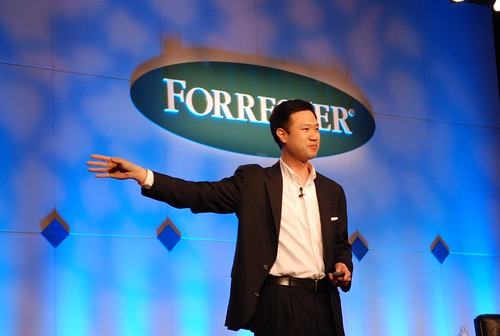
Peter Kim is currently working with a stealth-mode startup, building an enterprise social services and technology company. He was previously a Forrester Research analyst, focusing on social computing and marketing organizations. Prior to Forrester, Peter was in charge of PUMA’s global interactive marketing, internal creative agency, and marketing finance. He also held strategy consulting positions at Razorfish and Coopers & Lybrand.
Peter has been widely quoted on marketing in the press, including media outlets such as Advertising Age, Brandweek, and The Economist, as well as appearances on CBS, CNBC, CNN, and NPR. He has been a keynote speaker, effective panel moderator, and workshop facilitator for the ARF, AMA, DMA, Forrester and WOMMA, in addition to dozens of client events.